Watch a demo
Revolutionizing PV plant design: The power of 3D energy simulation
Discover how RatedPower’s 3D Energy simulation tool transforms PV plant design by moving beyond flat terrain assumptions to comprehensive 3D analysis.



Pascale Abou Moussa
Product Marketing Manager
Pascale is a marketing expert and Product Marketing Manager at Rated Power. With a background in Neuromarketing, she blends cognitive insights into her strategies. Passionate about understanding the customer needs, Pascale combines her expertise to make impactful contributions to the renewable energy sector.

Content
Utility-scale solar power plants have historically been built on flat, open spaces to facilitate design and construction. That’s been the case for some of the most prominent early deployments: Agua Caliente in Arizona spreads 4.9 million panels across a wide stretch of uniform desert terrain, while Bhadla Solar Park in India, which is among the largest in the world, was developed on an expansive, low-relief site in Rajasthan.
Although initially this is how solar farms were built, energy yield was calculated using simplified models, and in many cases, the estimates lined up well with on-the-ground performance.
Take a free product tour of the 3D estimation tool by RatedPower to see how you can run detailed, ray-tracing simulations in under an hour, test design variations, and generate the documentation your stakeholders need without ever leaving the platform.

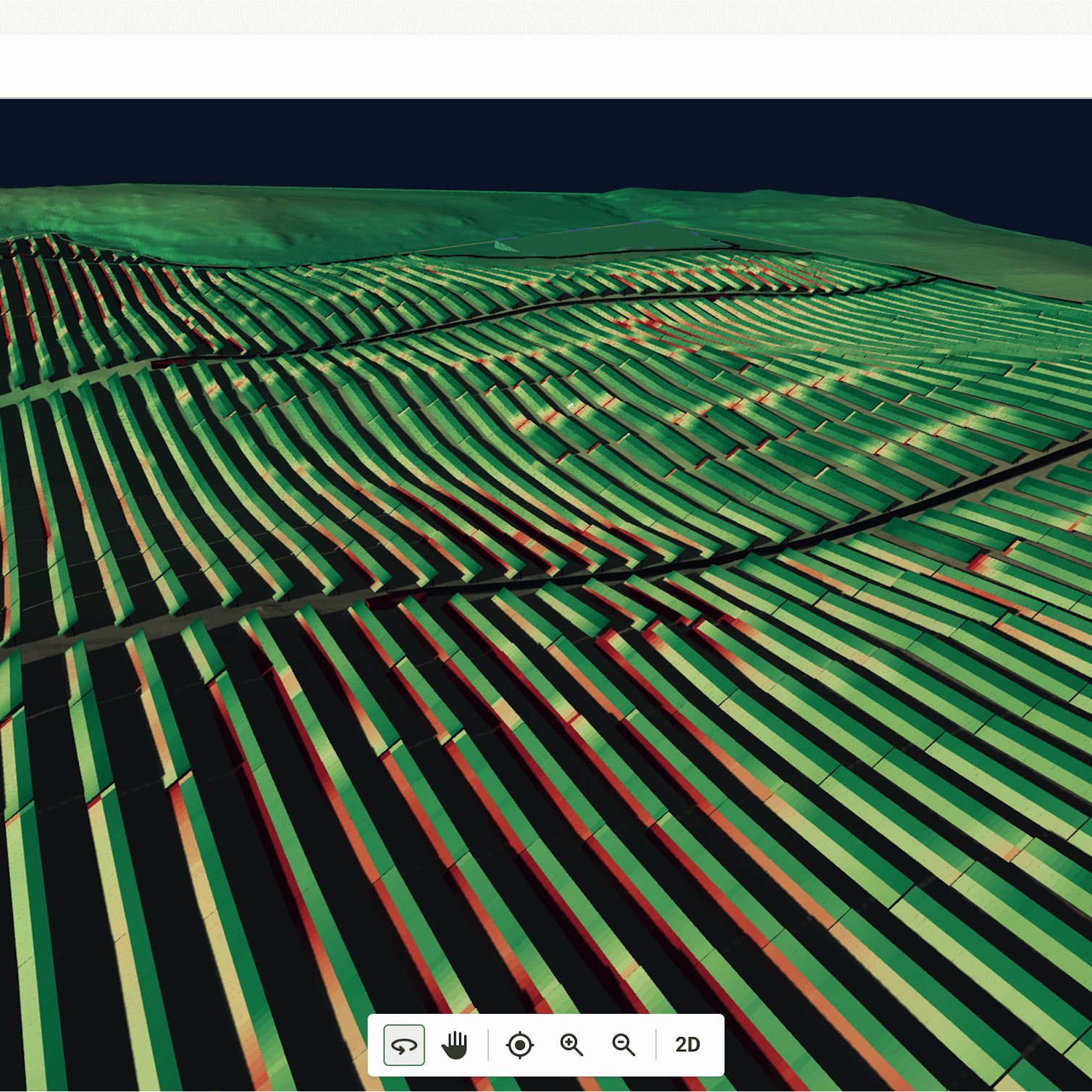
But land scarcity and environmental restrictions are pushing solar into much hillier terrain. Developers now need to model how a site’s contours might affect alignment and shading, and ultimately energy yield.
Our new 3D Energy simulation tool was built for that need. It brings full ray-tracing analysis and terrain-aware modeling into the RatedPower platform, so you can simulate exactly how the topography interacts with your layout choices.
Going from flat to 3D terrain modeling
For a long time, layout tools didn’t need to account for much more than row spacing and orientation, as grading land into a single plane was considered standard practice in utility-scale PV design.
But grading adds considerable costs and strips away natural ground cover, which can lead to erosion and runoff issues. It’s also problematic from a conservation perspective. Many heavily-graded sites have been criticized (or even blocked altogether) for removing native vegetation and disrupting wildlife habitats.
Fortunately, solar hardware has evolved to work with natural topography. Bifacial modules, along with improved tracker and mounting systems, have made it easier to deploy on non-uniform ground without major performance tradeoffs.
France was among the first to build a utility-scale solar plant on rolling hills back in 2015, but more of such projects, equipped with even better terrain-adaptive structures, have since been commissioned.
Japan’s Kanoya-Osaki Solar Hills came online in 2020 and now powers 39,000 households. China’s Guizhou plant covers an entire mountain range in panels and produces an impressive 15 million kilowatts of power as of 2025. Smaller but noteworthy projects such as the Cayanga Hillside Solar Farm are also under development in the neighboring Philippines.
This new siting strategy unlocks opportunities that would have been ruled out just a few years ago. But to make the most of them, your team needs to see how slope and shading might affect your layout before construction begins, so mistakes don't become costly.
Introducing 3D Energy
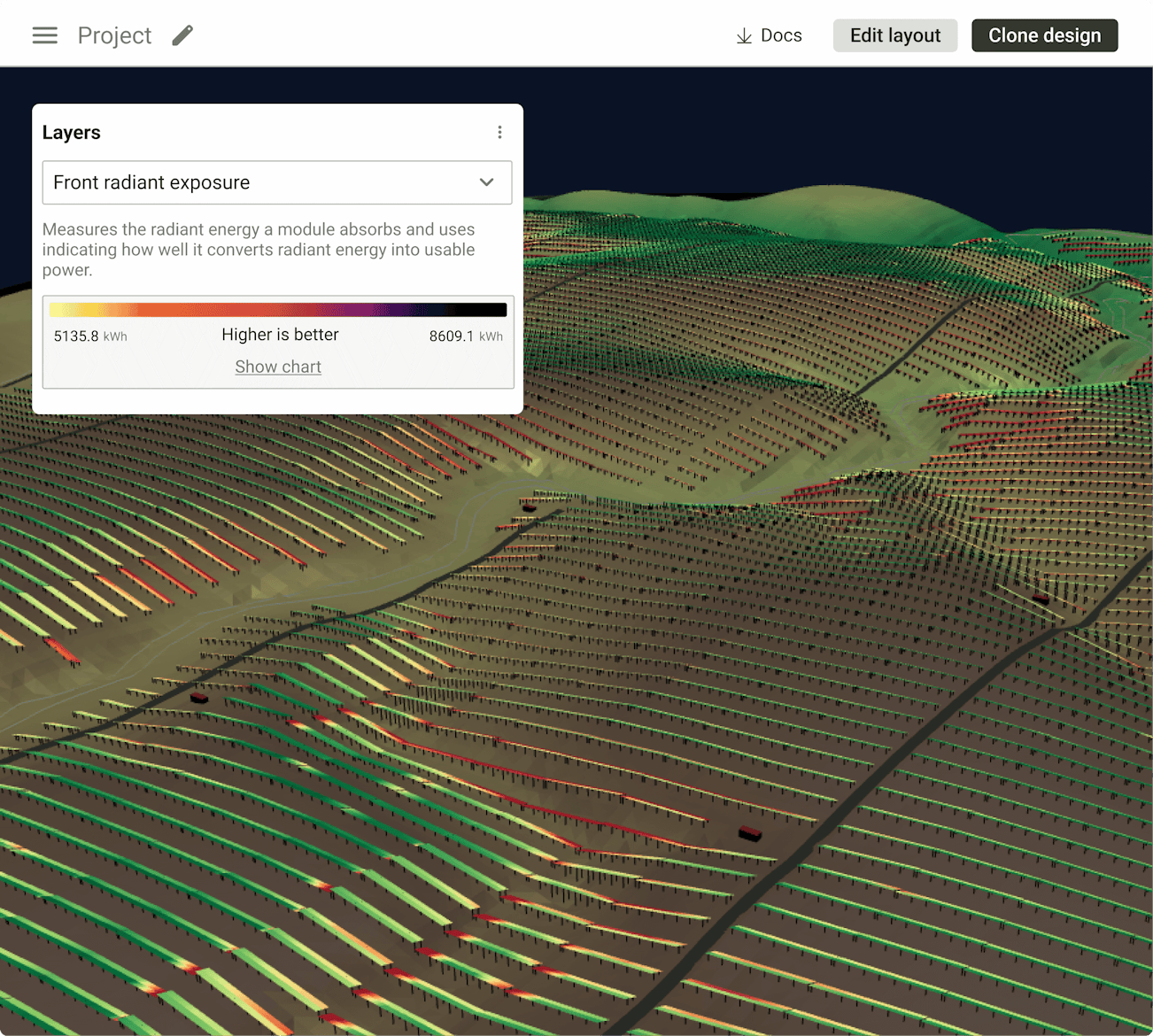
RatedPower’s 3D Energy simulation tool lets you do exactly that. It uses ray-tracing technology to model the physical reality of each site (i.e., how sun paths interact with topography and mechanical systems), resulting in more accurate, terrain-aware energy estimates. With 3D Energy, you no longer have to approximate terrain effects or switch to separate software to model energy yield on uneven ground.
How does 3D Energy work?
Much more than just a terrain visualizer, 3D Energy is a full-fidelity simulation engine that accounts for a range of real-world variables that affect production.
Topography: The tool maps actual terrain features to model how changes in elevation alter irradiance and shading throughout the day and year.
Edge effects: The simulation doesn’t generalize from average row behavior. It calculates how edges and gaps affect light capture at the array's boundaries.
Albedo and bifaciality: Reflected light and rear-side generation are modeled based on local terrain and bifacial module characteristics rather than average or assumed values.
Mutual shading: 3D Energy accounts for inter-row shading and near-field obstructions via ray-tracing, enabling layout optimization to directly improve production accuracy.
Terrain-aware backtracking: Instead of using a flat-surface backtracking algorithm, the tool dynamically adjusts tracking angles based on surrounding slopes to reduce self-shading losses.
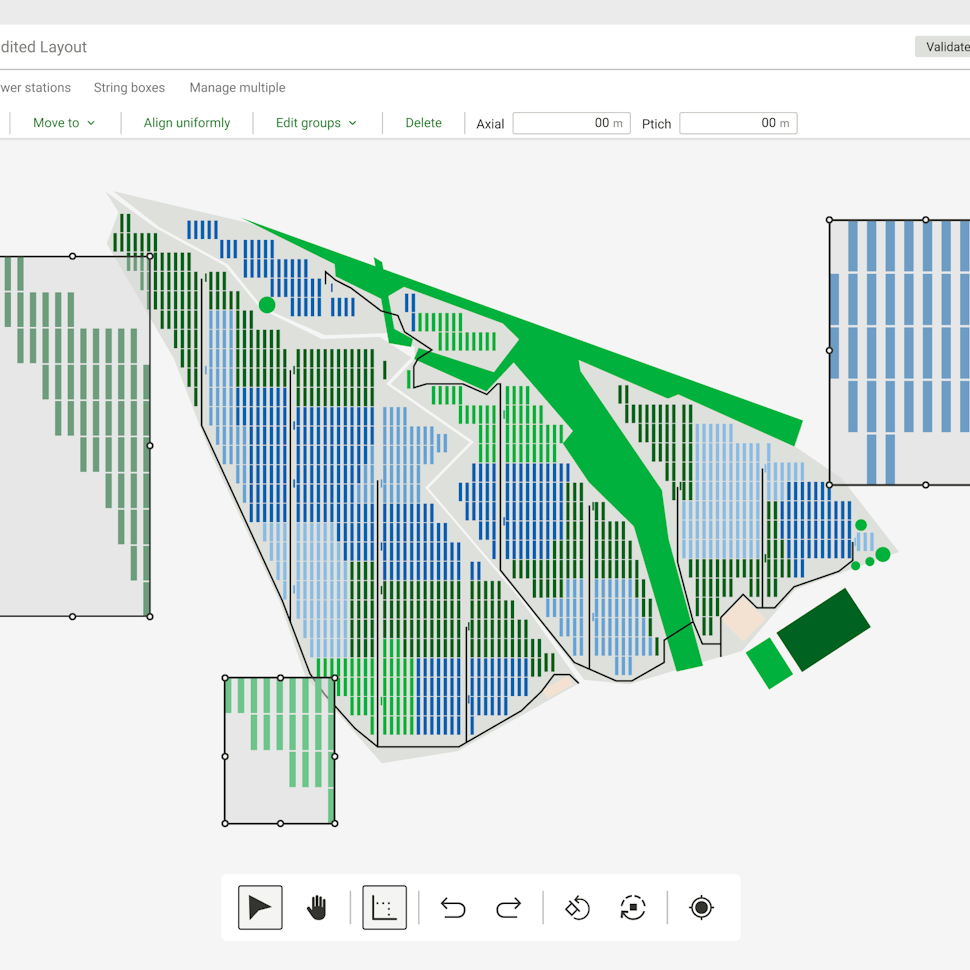
This level of detail goes beyond what traditional tools or flat-ground models can provide. And because it's fully integrated within RatedPower’s platform, you can run these complex calculations without exporting layouts or juggling multiple design environments.
It’s possible to complete full terrain-aware simulations in as low as 10min, depending on plant size, even for utility-scale projects.

Overcome shading challenges
Traditional energy simulation tools estimate shading using generic assumptions or simplified lookup methods. This causes developers to miss localized performance issues or, worse, overestimate yield and run into problems during financing or operation.
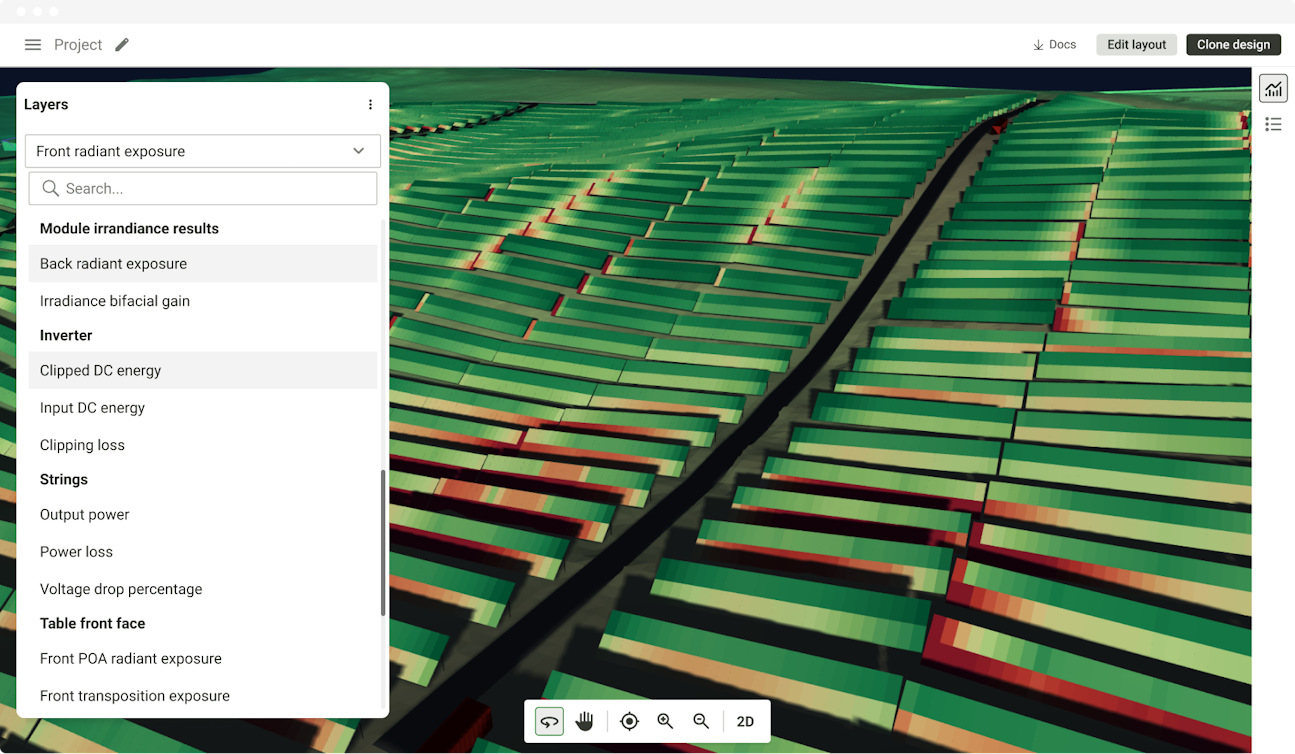
To address that limitation, RatedPower’s 3D Energy tool runs full ray-tracing simulations across the entire layout. Each module is evaluated individually to simulate shading based on its exact position, surrounding terrain, and mechanical configuration, so you can:
Detect problematic shading zones before construction.
Adjust layouts to reduce shadow-related losses.
Optimize tracker configuration for slope-aware backtracking.
Model bifacial generation more realistically, including rear-side shading.
Catch terrain-driven risks early
Projects that don’t model slope-related shading or elevation changes accurately often overestimate how much energy the system can produce once built. This can lead to contract issues with off-takers and make it harder to secure subsequent financing from lenders who require reliable production forecasts to justify their investment.
RatedPower’s 3D Energy simulation lets you avoid that by flagging where terrain-driven losses could occur, early in the design stage. Use it to compare production scenarios across multiple terrain configurations, identify where shading or geometry might reduce output, and adjust tracker orientations and spacing as needed.
And because RatedPower integrates design, simulation, and documentation in one place, those changes automatically flow into updated layouts and reports. You can download detailed records and project files in multiple formats (including PDF, CSV, AutoCAD (DWG or DXF), GLTF, and PVcollada), along with full documentation of the underlying methodology. By using these reports to show how you’ve addressed site constraints, you can win the trust of lenders and reduce risk during due diligence.
Design for what’s next with RatedPower
Terrain-aware design will become standard as more PV projects are built in complex environments. Solar design will no longer be about watts per square meter. It will be about identifying all possible constraints, quantifying their impacts, and refining the layout until yield, cost, and feasibility are in balance.
RatedPower’s 3D Energy simulation tool gives you the terrain-aware accuracy you need to design the next generation of high-performance PV plants.
Take a free product tour to see how you can run detailed, ray-traced simulations in under an hour, test design variations, and generate the documentation your stakeholders need without ever leaving the platform.
PV and BESS plot to production with RatedPower’s advanced features
This free Playbook shows you how to go from site prospecting to optimized PV plant and BESS design, helping you build an installation that hums at peak efficiency and inspires investor confidence.

Latest stories
Related posts
Product and corporate updates
Enverus’ Solar ROI calculator: assess PV plant’s profitability
Find out how much you could save by integrating Enverus tools into your solar design workflow, as we explain how our solar ROI calculator works.
Updated 5 AUG, 25


Product and corporate updates
Exploring the RatedPower CAD import tool
Discover the RatedPower CAD import tool, an intuitive and time-saving feature that directly integrates DWG CAD files and shapefiles into our platform.
Updated 17 JUN, 25

Product and corporate updates
Discover RatedPower’s Layout Editor
RatedPower’s Layout Editor combines precision, automation, and instant feedback to create a financially and commercially viable layout for a PV plant.
Updated 6 MAY, 25