Watch a demo
The rise of utility-scale PV + storage plants in Italy
Discover how Italy’s latest policies and auctions are driving utility-scale solar and battery storage projects to meet ambitious 2030 targets.



Emil Trepin
Account Executive
Account Executive with a strong track record in SaaS sales and business development across multiple European markets. I specialize in driving revenue growth, building strategic relationships, and scaling market presence for innovative tech solutions in the energy sector.
Graduated in International Studies at the University of Trento with a thesis on foreign policy decision-making. Title: “Foreign Policy Decision-Making: A Poliheuristic Explanation of Donald Trump's Decisions in the Middle East”. During my Bachelor's degree, I studied for 5 months at the Kaunas University of Technology (Lithuania) as part of the Erasmus+ program.
Graduated in International Relations at the University of Bologna with a final dissertation on U.S. semiconductor policy in the Indo-Pacific region. In 2023, I attended Dickinson College (Pennsylvania, USA) during the spring semester as part of the UniBo Overseas program.

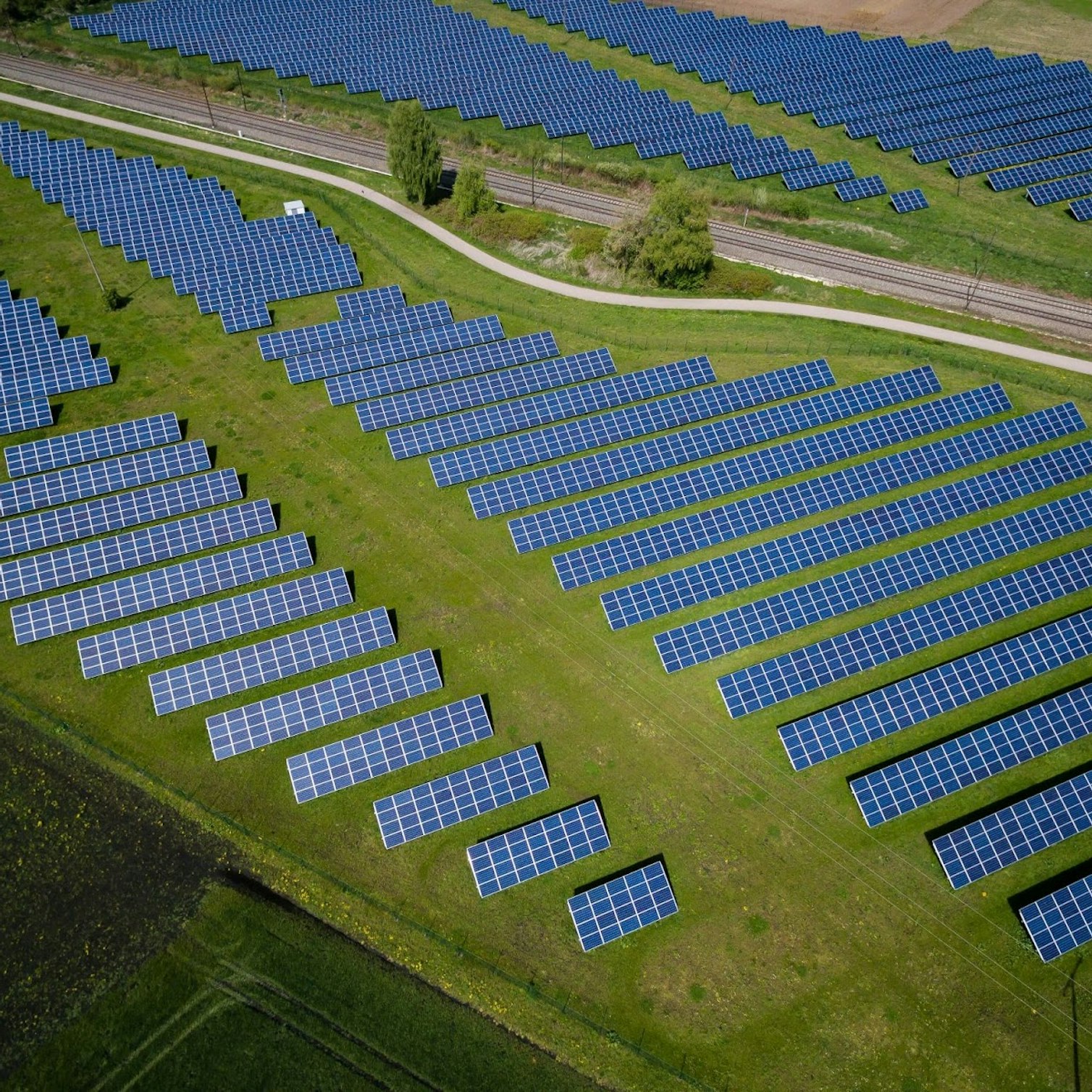
Italy is clearing space for solar and BESS as gas plants are gradually being phased out. By 2030, the government aims to more than double solar PV capacity from 36 GW at the end of 2024 to 80 GW. Wind power is also on track to increase from 13 GW to 28 GW. That’s a 59GW total increase in variable generation over just six years, and the grid must adjust for that intermittency.
But battery deployment is still behind the curve.
The country needs to install 15 GW of BESS by 2030, but only 1 GW of utility-scale BESS is online as of March 2025. Another 1.75GW is under construction, and 1.4GW has been permitted, but even if every project moves forward, total capacity would still be 11GW short of the target.
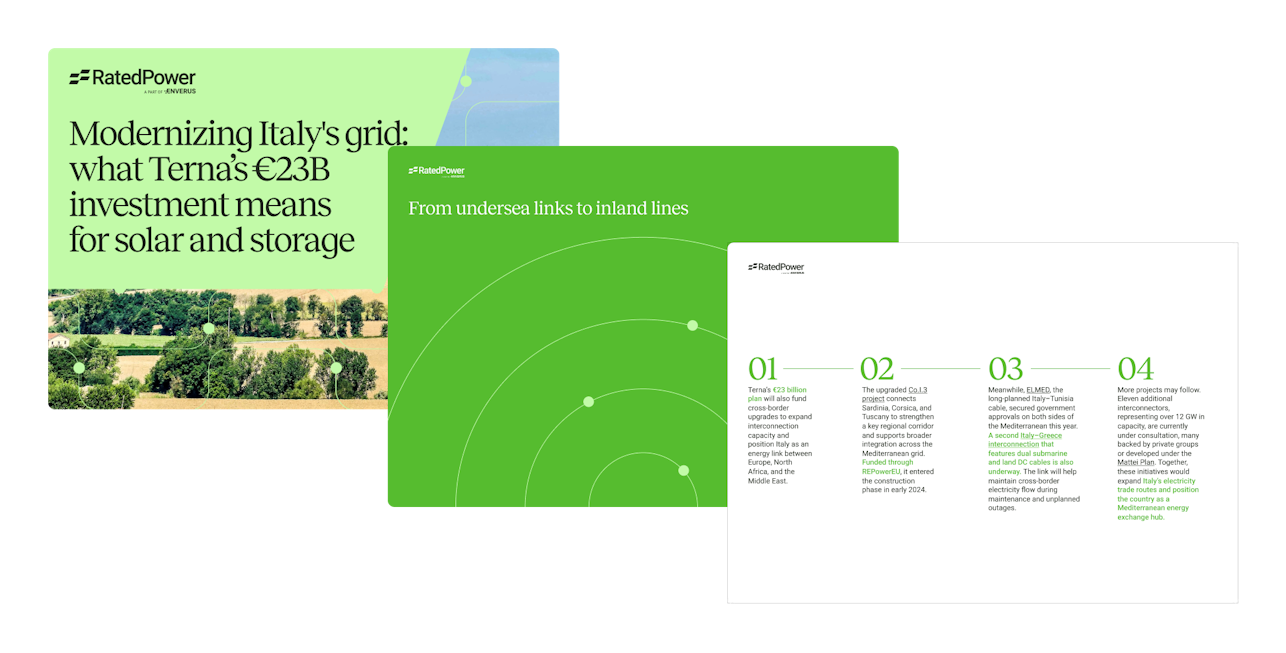
Italy is investing €23 billion to modernize its grid and unlock the full potential of solar and storage. Get insights on Terna’s plan to boost transmission capacity, cut congestion, and connect Italy with Europe. Download the Modernizing Italy’s grid: what Terna’s €23B investment means for solar and storage ebook now to explore the projects driving the country’s energy transition.

This shortfall has made PV + storage a national priority. In this blog, we look at the latest policies and auctions that support large-scale hybrid buildouts in Italy, and how investors are restructuring revenue models to meet new capacity and bankability requirements.
Market drivers
Italy’s growing solar PV capacity is changing price patterns across the grid. Midday generation pushes wholesale prices down while evening reliance on gas-fired plants (especially in the south and islands) keeps prices elevated. This volatility improves the revenue case for PV + storage systems that store solar output and discharge during higher-priced evening peaks.
Such hybrid systems are especially compelling in southern regions, where most solar buildout is occurring, and curtailment risk is rising. Pairing storage with PV in these areas helps capture more revenue and reduce wasted generation.
Investor interest is following. Around 20% to 30% of large-scale battery projects in Italy already include on-site solar, with that share expected to grow as developers prioritize better land use and more reliable returns.
Policy support
Regulatory changes are advancing alongside market trends. Italy is overhauling its dispatch rules under the TIDE reform package, a multi-year effort to modernize electricity scheduling and pricing across the grid. The changes (which began rolling out in early 2025 and will continue through 2029) aim to align the country’s market framework with European standards.
TIDE reform package
The first adjustments under TIDE are already in effect. Since Q1 2025, intraday and imbalance markets have switched from hourly to 15-minute intervals, and in Q2, the day-ahead market began using both hourly and 15-minute pricing models in parallel. These updates give market participants clearer price signals and BESS operators more chances to earn from short-term price swings.
A new system balancing strategy
Italy is also changing its system balancing strategy. A new structure will replace the current dispatching market and introduce a market-based Frequency Containment Reserve, a fast-response service used to stabilize grid frequency in real time. Italy also plans to join European balancing platforms like PICASSO, MARI, and TERRE, which could expand future revenue options for batteries that provide ancillary services.
MACSE auction mechanism
Alongside these reforms, Italy also introduced an auction mechanism specifically for storage: MACSE. Grid operator Terna launched this capacity tender in 2025 to bring another 11GW of storage online and move the country closer to its 2030 target of 15GW.
Unlike earlier programs, MACSE awards contracts based on energy capacity, making it better suited to longer-duration systems. It also allows developers to decide how much of their storage capacity to commit under a 15-year tolling agreement with Terna, while retaining the remainder for merchant trading. That partial contracting model is useful for co-located PV + storage projects where operators can store surplus solar that might otherwise be curtailed and sell it later at higher prices.

Investor interest
Investors are now actively pursuing BESS opportunities structured to participate in the 2025 MACSE auction, particularly four-hour standalone systems designed to maximize round-trip efficiency and meet minimum duration thresholds while operating within Terna’s derating and dispatch parameters.
On the renewable energy marketplace nTeaser, over 50% of the MACSE-targeted pipeline is concentrated in Southern Italy, where grid access is more available and regional price spreads strengthen the case for arbitrage. From March 2024 to February 2025, daily trading spreads in Sardinia were 42% higher than in northern Italy, making merchant returns more compelling. The south sees more volatility due to its high solar penetration and weaker interconnection with the rest of Europe. By contrast, the north benefits from hydropower, slightly more grid stability, and strong cross-border connections.
This regional skew is no accident because Terna’s MACSE contracts are allocated to specific zones (including Centre-South, South, Calabria, and the islands) with a minimum 500MWh requirement for each island region. The north is excluded entirely, as it already accounts for the bulk of Italy’s installed battery capacity. For northern projects, investors typically model returns from ancillary services such as fast reserve and MSD (Mercato dei Servizi di Dispacciamento, the Italian market for ancillary services), as well as market arbitrage between intraday and day-ahead prices. Investors outside MACSE zones can also secure another fixed revenue stream through capacity market contracts.
Given these conditions, many investors now pursue a hybrid strategy: secure MACSE-backed income for part of the asset and keep the rest exposed to market opportunities to manage risk while maintaining upside potential. Institutional funds, meanwhile, often prefer fully contracted PV + storage projects, especially when the PV component qualifies for FER X or is backed by a long-term PPA.
These conditions have contributed to the rise of co-located PV + storage systems, which appeal to institutional investors because they store excess solar that would otherwise be curtailed. They also share substations and land to reduce infrastructure costs and support revenue stacking. Some developers are adding storage to existing PV plants or converting standalone battery systems into hybrids to meet investor requirements for better financing terms.


What’s next for BESS investors?
Italy’s storage market is moving toward projects with longer discharge durations. Four-hour systems remain standard for MACSE, but developers are already looking at eight-hour projects in high-solar areas.
Recent policy reforms combined with the launch of MACSE have made project structuring more predictable. In southern and island zones with wider price spreads, hybrid strategies combining auctions, capacity contracts, and merchant trading are becoming the default. Co-located assets will likely drive the next wave of utility-scale storage in Italy.
Early Bird 50% off for PULSE 2026 is live!
Join hundreds of global renewable energy professionals, gain industry insights, and make valuable connections. Don't miss out!!

Latest stories
Related posts
Market analysis
From Loi Grémillet to PPE3: What France’s energy shift means for solar
Discover how the Grémillet bill reshaped France’s energy debate, and how the final PPE3 decree now defines the roadmap for solar and renewables through 2035.
Updated 17 MAR, 26


Market analysis
A look at the largest-scale solar projects across the UK
Find out more about how the UK is developing substantial solar power projects, including the Queequeg Renewables Solar PV Park and the Botley West Solar Farm.
Updated 24 FEB, 26


Market analysis
Battery Storage in Africa: From Backup to Backbone
See why Africa is prioritizing off-grid battery storage that operates independently, as 50% of its population doesn’t have access to a stable power supply.
Updated 19 FEB, 26