Watch a demo
BESS sizing in Italy: how smarter design protects margins in a competitive market
Italy's BESS market is tightening fast. Learn how smarter BESS sizing protects margins, and download our free sizing guide to model your project.



Emil Trepin
Account Executive
Account Executive with a strong track record in SaaS sales and business development across multiple European markets. I specialize in driving revenue growth, building strategic relationships, and scaling market presence for innovative tech solutions in the energy sector.
Graduated in International Studies at the University of Trento with a thesis on foreign policy decision-making. Title: “Foreign Policy Decision-Making: A Poliheuristic Explanation of Donald Trump's Decisions in the Middle East”. During my Bachelor's degree, I studied for 5 months at the Kaunas University of Technology (Lithuania) as part of the Erasmus+ program.
Graduated in International Relations at the University of Bologna with a final dissertation on U.S. semiconductor policy in the Indo-Pacific region. In 2023, I attended Dickinson College (Pennsylvania, USA) during the spring semester as part of the UniBo Overseas program.

Content
- Why usable BESS capacity is lower than nameplate
- Why BESS sizing accuracy matters more in Italy's auction market
- How to model BESS configurations before committing to a design
- How faster scenario testing reduces sizing risk
- What lenders and investors require from BESS project models
- Frequently asked questions
Italy's battery energy storage system (BESS) market is growing fast, but margins are tightening as auction prices fall and competition increases. Developers who size their systems accurately from the start capture more revenue per megawatt-hour and are better placed to defend returns when auction prices compress further.
Terna's Mercato per il Capacity Storage Elettrico (MACSE) mechanism has improved the bankability of BESS projects in Italy by offering successful bidders a 15-year guaranteed income stream. But the first auction round also triggered a pricing dynamic that is likely to persist. Contracts settled at €12,959/MWh/year, a benchmark that some analysts consider strikingly low for the revenue it implies over a project's operational life.
Oversubscription, by as much as 4x in some cases, reflects how much capacity is chasing a limited pool of contracted volume. As more projects compete for the same auctions, the pricing pressure on future cycles is likely to hold. Returns are already constrained. Small sizing mistakes that might have been absorbed in a more generous revenue environment now have a direct impact on whether a project is viable.
Understanding Italy's broader renewables context is useful here. The country's push toward net zero is driving demand for storage capacity alongside solar, but the commercial terms under which that storage is contracted are tightening.
Why usable BESS capacity is lower than nameplate
Revenues are already compressed, so BESS projects must extract as much usable energy as possible from every unit of installed capacity. That is harder than it sounds, because battery systems do not scale linearly. Doubling storage duration or energy capacity does not double cost: it adds hardware across the full system, increasing total capital expenditure (CAPEX) at a rate that quickly puts pressure on cost-per-MWh figures.
Even after installation, not all nameplate capacity is available for dispatch. Losses occur on both the charge and discharge paths. State-of-charge limits cap how much energy can actually be extracted. Dispatch rules restrict how frequently the system can cycle and during which periods. Miss the high-value charge windows, or cycle at the wrong time, and revenue falls while costs per MWh climb.
Oversized systems run into the same problem from a different direction: they spread fixed costs over fewer usable MWh, which worsens the economics even when the battery itself is performing correctly. Getting the sizing right before financial close is a core design decision.

Why BESS sizing accuracy matters more in Italy's auction market
There is still meaningful capacity to be won. MACSE aims to procure 50 GWh of grid-connected storage by the end of the decade and has awarded roughly 10 GWh as of October 2025. Developers who size their projects correctly from the outset have a structural advantage in future rounds: lower cost-per-MWh, better revenue capture per cycle, and a model that holds up under lender scrutiny.
The challenge is that the variables affecting sizing are interdependent. Storage duration, power-to-energy ratio, dispatch strategy, and cycle frequency all determine how the system earns across its contract life. Coupling topology is one further variable for hybrid configurations, but for standalone grid-scale BESS, the dominant project type in Italy, duration and dispatch are the primary levers. Italy's regulatory approval environment adds further complexity: permitting timelines and grid connection requirements to affect when a project can realistically begin generating revenue, which feeds directly into how duration and dispatch are optimized.
In a market where auction prices are already at the low end of analyst expectations, the difference between a well-sized and a poorly-sized project is not marginal. It can be the difference between a project that closes financing and one that does not.
If you are working through BESS sizing decisions for an Italian project, the RatedPower BESS sizing guide covers the methodology in detail, including how coupling configuration, duration, and dispatch strategy interact across different revenue scenarios.
How to model BESS configurations before committing to a design
Sizing a BESS requires tuning several interdependent choices, each of which affects both energy flows and revenue timing:
● How many hours of storage are installed, and the resulting power-to-energy ratio (1h, 2h, 4h and above).
● What dispatch strategy is applied: optimizing for peak price periods, frequency response, or a hybrid approach.
● How frequently the battery cycles and at what depth of discharge.
● How the system degrades over the contract term and how that affects usable capacity in later years.
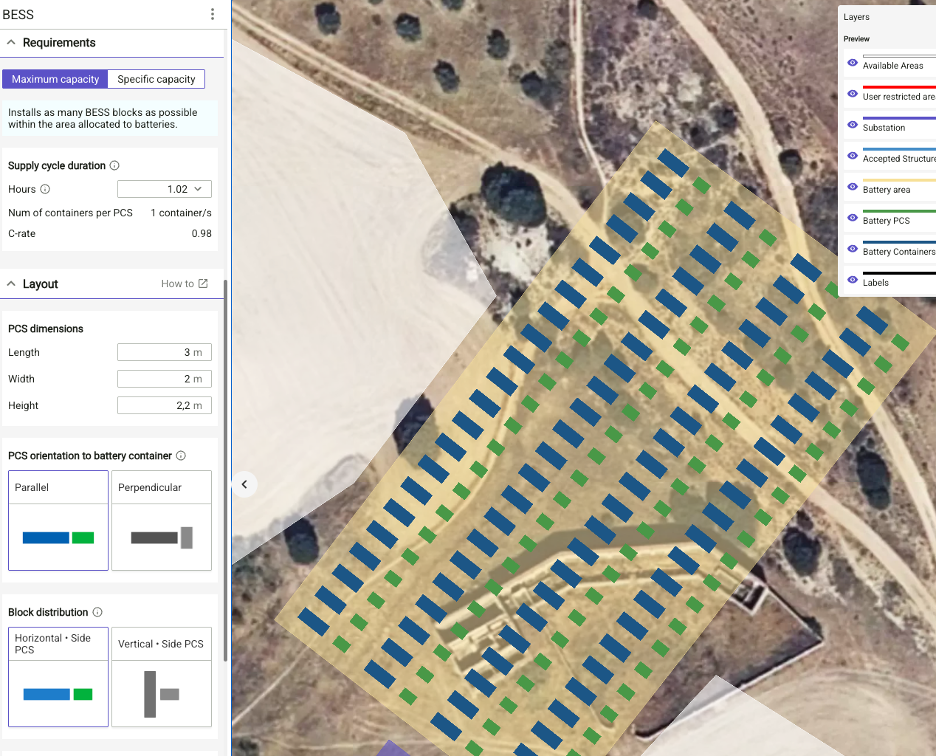
RatedPower models these configurations on the same project design, so teams do not need to rebuild the model each time a scenario changes. Different storage durations, dispatch strategies, and cycle profiles can all be run against a consistent set of inputs, which keeps technical and financial models aligned at the source. Where a project does involve co-located solar, AC/DC coupling is also a configurable variable within the same workflow.
The platform captures how the system behaves over time rather than relying on hourly averages. It models when the battery charges from the grid, how stored energy is dispatched into higher-price periods, and how state-of-charge evolves across each day and season. Because revenue in Italy is concentrated in a small number of high-price hours, the timing of dispatch matters more than total energy throughput. RatedPower simulates performance at sub-hourly resolution, so teams can see exactly when energy is charged, stored, and sold, and which price periods the system is operating in across its full operational life.

How faster scenario testing reduces sizing risk
Small changes to a standalone BESS design can have an outsized effect on project returns, and the interactions are not always intuitive. Increasing storage duration raises the energy available for high-price dispatch but also increases CAPEX and the minimum revenue required to break even.
Adjusting the cycle frequency affects how quickly the battery degrades, which in turn affects usable capacity and revenue in later years of the contract. Changing the dispatch strategy, for example, moving from peak price arbitrage to a mixed frequency-response and arbitrage approach, shifts when the system earns and how exposed it is to price volatility.
The DC/AC ratio remains relevant where solar is involved, but for standalone BESS the variables that move the dial are duration, depth of discharge, and dispatch logic.
None of these decisions can be evaluated in isolation, and testing combinations manually is slow. Traditional workflows often require building the layout in one tool, simulating performance in another, and modeling financials in a third, with assumptions re-entered at each handoff. The practical result is that teams test fewer configurations than the project warrants, and the decisions that get made are constrained by what is feasible to test rather than what is technically optimal.
With RatedPower, multiple configurations run on the same base design. The comparison is available in minutes rather than days. That speed matters most early in the design process, when changes are still low-cost: it allows teams to identify trade-offs that would reduce revenue capture or increase cost-per-MWh if left untested, and to arrive at financial close with a design that has been stress-tested against the actual auction and dispatch environment in Italy.
For further context on the Italian storage market and how grid connection timelines affect project planning, the Italy TSO connection guide sets out the connection requirements and common causes of delay.


What lenders and investors require from BESS project models
Utility-scale BESS projects in Italy are not evaluated solely on total energy throughput. Lenders and investors assess how consistently the system performs across different price periods, how clearly design assumptions translate into energy flows and dispatch outcomes, and how much stored energy reaches high-price windows. The Italian storage market has matured to the point where financiers are familiar with BESS project structures and expect to see models that can be interrogated at the input level.
RatedPower produces outputs that connect directly to design inputs. For BESS projects, teams can generate and review:
● A bill of quantities (BoQ) that links system design to CAPEX.
● Time-based outputs that show how the PV system and battery operate together across the year.
● Outputs showing how much energy is stored, shifted, and dispatched into higher-price periods.
● Scenario comparisons showing how different configurations affect energy capture and revenue potential.
Change the storage duration, cycle depth, or dispatch logic, and the impact appears directly in how energy moves through the system and in the revenue tied to those movements.
That traceability is what makes a model defensible in a financing discussion: each number has a specific input behind it, and changing assumptions does not require rebuilding the case from scratch.
In a market where auction pricing leaves limited room for conservative assumptions, the ability to walk into a lender meeting with a model that is both specific and auditable is a genuine commercial advantage.
Frequently asked questions
Why is usable BESS capacity lower than nameplate?
Losses on the charge and discharge paths, state-of-charge limits, and dispatch rules all reduce the energy a BESS can actually deliver. Oversized systems compound this by spreading fixed costs over fewer usable MWh, increasing cost-per-MWh even when the hardware is performing correctly.
Why does BESS sizing accuracy matter more in Italy's auction market?
MACSE auction prices settled at €12,959/MWh/year in the first round, with demand oversubscribed by up to 4x. In a market with constrained revenues and high competition, small sizing errors that might have been absorbed elsewhere now affect project viability directly.
What do lenders and investors require from BESS project models in Italy?
Financiers expect models that are auditable at the input level: a bill of quantities tied to CAPEX, time-based dispatch outputs, and clear traceability between design assumptions and revenue outcomes. They assess performance across price periods, not only total throughput.
Schedule a demo to see how RatedPower models BESS configurations for the Italian market.
Western Balkans: A New Era of Renewable Energy Investment and Environmental Change
Download this eBook to explore how Western Balkans is becoming a critical player in Europe’s green energy future.

Latest stories
Related posts
Technology and engineering
How 3D Planning Is Accelerating Solar Deployment in Finland
Find out how 3D solar design and digital permitting are transforming Finland’s energy development, streamlining workflows, and ensuring regulatory compliance.
Updated 24 MAR, 26



Technology and engineering
Outsmarting congestion: How efficient solar design helps navigate Nordic grid limits
Learn how Nordic operators and solar developers are adjusting to tighter grid conditions and how policy and design decisions are keeping projects on track.
Updated 16 DEC, 25

Technology and engineering
The rise of ultra-thin perovskite solar cells
Learn about Japan’s $1.5B initiative to commercialize ultra-thin, flexible perovskite solar cells and how it could transform the solar landscape globally.
Updated 30 SEP, 25